
Our MA English program will help you to develop the critical reading, writing, and thinking skills needed for the next step on your career path, whether you are pursuing a career in writing or editing, advancing your training, preparing for doctoral studies, or advancing to professional licensure* or beyond.

Title

Header

Program Features

  • Two concentrated study options: Students can pursue literary studies or writing. 

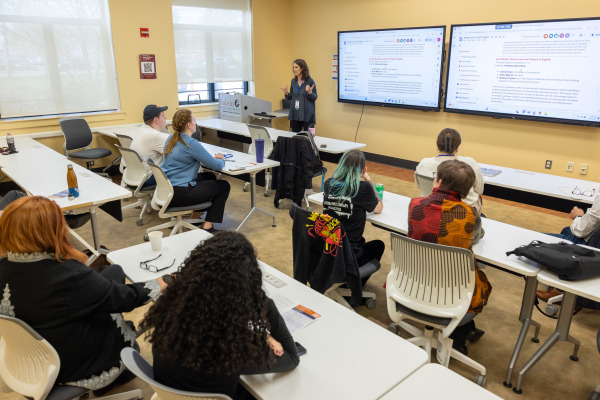
  • Small class sizes: Most courses at the graduate level are conducted with approximately 15 students. 

  • Flexible pacing options: This program can be completed in 1.5 to 2 years full-time or 2 to 6 years part-time. Combination of in-person and online course offerings, with all courses starting at 4:30 pm or later. 

  • Faculty: The Salem State University English department is an active community of scholars and writers who regularly publish and contribute to their fields. The graduate faculty prepares students for various professions while remaining committed to the core traditions of literary analysis, creative process, and community engagement, as well as sharing scholarship and creative work with the campus community and the broader public. 

  • Concurrent enrollment opportunities: Certificate in Digital Studies; Certificate in Holocaust and Genocide Studies; Certificate in Writing and Rhetoric

  • Graduate assistantships: Opportunities to apply for graduate assistantships, grants and scholarships. 

Our master of arts in English allows students to concentrate in either literature (30-33 credits) or writing (30 credits), depending on their interests and professional goals.

The concentration in literature focuses on literary texts, scholarly criticism, and research. It is recommended for those seeking careers that build on critical and analytic reading and writing skills, current teachers pursuing professional licensure, and those interested in pursuing doctoral studies in English. Degree candidates pursuing literary studies may choose to write a master’s thesis or portfolio.

The concentration in writing is designed for those who want to pursue careers in writing. Candidates of writing studies will complete a capstone manuscript in the student’s primary genre.

  • Master’s in English Regional Conference (MERC): Salem State and Bridgewater State co-organize this annual conference. Salem State master’s students regularly present with peers from New England at the conference. 

  • Graduate Student Reading: Each spring, Salem State hosts a graduate student reading where students on the writing track present their work. 

  • Salem State University’s Research Day: Graduate students and faculty present papers, posters, and workshops about their ongoing research. 

  • Writer’s Series: English graduate students can enjoy a meal and discussion with the prominent writers who speak at Salem State’s Writer’s Series, such as Carmen Maria Machado, Brian Brodeur, and Ha Jing. 

  • Submittathon: Salem State’s English department hosts a submittathon at least once per semester. During this event, students gather to support one another and, under the direction of a faculty member, submit works for publication. 

  • Publications: Salem State’s English Department publishes the national literary journal Soundings East and the e-zine Red Skies. Master’s students in English have the opportunity to serve on the editorial boards of both publications. 

  • Professional Literary Studies, Writing, and Composition and Rhetoric Societies: Many of our students belong to professional associations such as CCCC and the Northeast Modern Language Association and present at their annual conferences.

English master’s students bring highly valued critical thinking and communication skills to the workplace. 

Sixty-six percent of our graduates are employed in education, eleven percent in marketing, sales, business, and healthcare management, and others in writing, editing, publishing, communications, or work in state and local government and public and school libraries.

  • Higher Education Administration, Emerson College 

  • English Department Program Coordination, Triton Regional School District 

  • Director of Human Services, All Care VNA 

  • Digital Content Manager, Philips Research America 

  • Director of Museum and Archival Services, Swampscott Public Library 

  • Editor, EBSCO Information Services 

  • Communications Consultant, Fidelity Foundation 

Our graduates have also pursued doctoral work, most frequently in English, composition, rhetoric, and law, and become lawyers and tenured professors.

Critical Analysis: Graduates will be able to analyze literary and critical texts, in relation to both particular contexts and big questions.


Students will recognize issues in representation, aesthetics, and ethics as they are posed in and by literary and critical works, analyze the issues in relevant critical and theoretical framework(s), and compose analytic arguments compelling to a variety of audiences.


Students will contextualize their analyses in terms of literary and critical history, social and political dynamics, genre and rhetorical situation.


Students will use close and distant reading techniques and technologies to analyze.


Creative Thinking: Graduates will be able to combine or synthesize existing ideas, images, or expertise in original ways and to think, react, and work in an imaginative way characterized by a high degree of innovation, divergent thinking, and risk taking


Students will analyze and practice theories and examples of literary imagination, invention, and reproduction


Students will experiment with new genres, approaches, and ideas.


Students will integrate divergent or contradictory perspectives in their analytic and/or creative work.


Students will study and practice literary and critical innovation.


Students will connect, synthesize, and transform ideas and practices from distinct authors, contexts, and experiences.


Critical and Creative Writing. Students will present their critical analyses in clear, compelling prose for a variety of audiences and will draw on creative skills and techniques in both critical and creative writing. Graduates will be able to communicate effectively orally and in writing.


Students will demonstrate the ability select and employ the standard conventions for specific genres and audiences as appropriate to their goals and audiences.


Students will experiment with composing in various genres and conventions. 


Students will engage in the full writing process, from drafting through various modes of receiving, giving, and responding to feedback to revision and polishing.


Global and multicultural perspectives: Graduates will be able to analyze and evaluate texts from global perspectives and to identify and address diversity issues in dominant and non-dominant texts.


Students will read texts from across world literature and analyze all texts with full consideration of global contexts, worldviews, and perspectives.


Students will read texts from diverse authors and perspectives, identify and analyze issues in diversity, power dynamics, and social justice, and compose analyses that address those issues.


Students will interrogate their own positions and perspectives in relation to the global and multicultural texts that they read and perhaps also create.


Students will practice empathy and demonstrate curiosity and openness as they consider global and multicultural texts, authors, and readers.

Explore Pathways to a Career in Teaching English in Grades 5-12

If you want to pursue a career teaching English in grades 5-12 and do not yet have an initial license, consider the MAT English program.

  • MA English: for those seeking to advance their training, pursue a career in writing/editing/communications, prepare for doctoral study, or advance to professional licensure or beyond in their secondary teaching career.

  • MAT English: for those seeking initial licensure to teach English at the middle and secondary levels in the Commonwealth of Massachusetts.

  • MA/MAT English: Admission for this program is currently paused.

If you have any questions about which program would be the best fit for you, please reach out to graduate admissions.

Take the Next Step

Apply now!

Contact Us

Want to learn more about the English program? Contact the program coordinator, Keja Valens.

For admissions-related questions, please contact graduate admissions. 

Graduate Admissions

Monday-Friday, 8:30 am-5 pm
331 Lafayette St.
Second Floor,
Salem, MA 01970
Mailing Address:
352 Lafayette St.
Salem, MA 01970
Back to top