
| Contact |
Dustin Luca
|
|---|
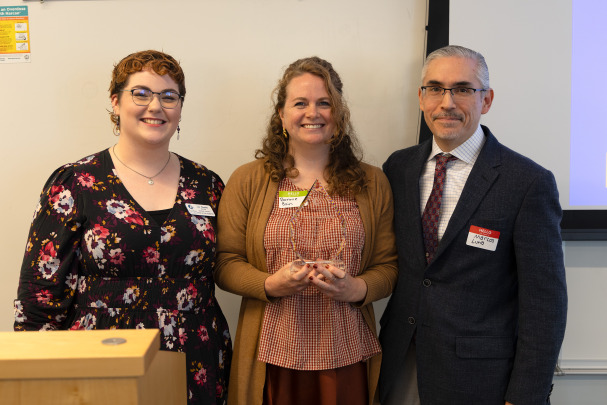
For 25 years, Salem Alliance for the Environment (SAFE) has worked to protect the environment and improve the health and well-being of Salem residents. Along the way, the nonprofit has become a valuable partner to Salem State University, connecting students and faculty with opportunities to address environmental challenges facing the community.
In recognition of that longstanding relationship, Salem State’s Center for Civic Engagement has presented SAFE with its 2026 Community Partner Award. The award was presented at the Center’s annual Community Partner Breakfast on Wednesday, November 18, the day before SAFE celebrated a quarter century of environmental advocacy and community engagement in Salem with its own ceremony on Thursday, November19.
"We are thrilled to honor SAFE with the Community Partner Award this year,” said Katelyn Adams, associate director of Salem State’s Center for Civic Engagement. “They have been an integral part of our campus community for decades, working alongside faculty and staff across academic disciplines and departments. This partnership is rooted in reciprocity and has been so beneficial both to the organization and Salem State University. Working with executive director Bonnie Bain has been an absolute pleasure, and we are so grateful to work alongside SAFE to advance environmental justice work in the city of Salem."
SAFE’s relationship with Salem State stretches back at least two decades, beginning with collaborations around Earth Days programming. Pat Gozemba, a former Salem State faculty member and co-founder of SAFE, helped connect the university’s environmental initiatives with the broader community alongside her romantic partner, SAFE co-founder Karen Kahn.
Under the leadership of executive director Bonnie Bain, the relationship with Salem State has expanded to include research collaborations, educational programming, and opportunities for students to apply their classroom learning to environmental challenges throughout Salem.
“SAFE has been particularly and uniquely involved in the community and at Salem State—a really important conduit for civic engagement between the university and community,” said Marcos Luna, professor of geography and sustainability at Salem State. “SAFE has been a really valuable ally, bridge, and contributor to the university community.”
Collaborations between SAFE and Salem State have included research into urban heat risks and resident-led solutions in Salem’s Point neighborhood and, more recently, the development of a community air-quality monitoring network. Working with SAFE and other community partners, Salem State students have helped establish a network of sensors collecting air-quality data throughout the city. Salem State’s Center for Entrepreneurship, Economic Development and Sustainability (CEEDS) is currently developing a public-facing bilingual dashboard and phone application in collaboration with residents to make that information accessible, with a launch for that dashboard anticipated in 2027.
The partnership reflects SAFE’s broader commitment to environmental health and justice, a mission that has guided the organization since its founding in 2001. SAFE’s early advocacy included efforts to close the coal-fired Salem Harbor Station power plant, followed by work identifying natural gas leaks throughout the city, including a disproportionate amount of leaks in The Point.
Since then, the organization’s mission has grown alongside its impact. Today, SAFE cultivates environmental justice in Salem, drawing on the city's history to work toward a resilient future grounded in climate justice. The organization collaborates with the people who live closest to the harm as they identify priorities, develop solutions, and advocate for change. Through civic engagement and collective learning, SAFE convenes residents, community leaders, and institutional partners to confront injustice, past and present.
Given the organization’s work in a predominantly Spanish-speaking neighborhood in the last two years, SAFE also integrates language access and strives for language justice via a well-attended monthly convening.
More recently, the organization has also advocated for the redevelopment of Salem’s waterfront to support offshore wind energy, while organizing a coalition to design and implement a community benefits agreement that invests in local jobs, funding for schools and early education, and funding for bilingual communications while codifying a deadline for port electrification.
“SAFE’s work has never been about the environment separate from people. It has always been about the environment for people,” Luna said. “Whether they’re looking at climate change risks and resilience, or air quality and other risks that might face a community, SAFE is in that particular spot where they’re looking out for people’s health and welfare in the environment.”
That commitment to public health and the environment has made SAFE an important collaborator in Salem State’s mission as the Commonwealth’s Civic Engagement University, providing opportunities for students to contribute to their community while developing the knowledge and skills to address complex challenges.
“Salem Alliance for the Environment thrives when we truly lean into being in alliance with our partners, such as Salem State University,” Bain said. “Whether it's Earth Days, internships, research, or communications support, SAFE could not do what we do with our small budgets and big ideas without an anchor institution in our community like Salem State!”
The Community Partner Award presentation took place one day before SAFE’s 25th anniversary celebration on Thursday, November 19, recognizing an organization whose advocacy has helped shape Salem’s environmental future and whose partnership with Salem State continues to create opportunities for the next generation of environmental leaders.
For more on SAFE, please visit its website at salemsafe.org.