
| Contact |
Department Chair, Lorri Krebs
|
|---|
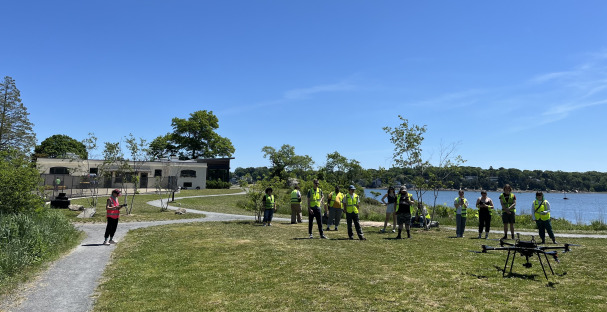
Thirteen Salem State University Discovery Scholars spent the early summer transforming Forest River Park into a living laboratory under the guidance of Geography and Sustainability faculty member Nicholas Geron.
From May 28 through June 29, the students participated in the Trees and Seas Discovery Scholars program, gaining hands-on experience in urban forestry, geographic information systems (GIS), drone technology, environmental fieldwork, and data analysis. Together, the scholars contributed more than 600 hours to research addressing the health and management of urban trees, the performance of Salem’s living shoreline, and the environmental benefits of a recently planted Miyawaki forest.
The program began with a tour of Forest River Park and an introduction to GIS and urban forestry concepts. Students then worked with Geron and their peer mentors to develop research questions about the park’s trees and living shoreline.
Beginning June 1, small teams surveyed every mature and young tree in Forest River Park—337 trees in total. Students collected information about tree species, health, condition, and potential management concerns. Their findings revealed that tree planting following the removal of ash trees in 2023 has increased the park’s overall tree biodiversity. The survey also identified concerns requiring attention, including potentially hazardous trees near walking paths and standing dead trees that may need to be removed.
The scholars expanded their research beyond Forest River Park when they traveled to Belmont High School to conduct a drone survey of a Miyawaki forest planted in October 2025. Miyawaki forests are small, densely planted areas designed to encourage rapid growth and biodiversity using native tree species.
Students helped program and fly drones to gather elevation, temperature, and vegetation-health data. Their analysis found a clear relationship between vegetation health and temperature: healthier vegetation was associated with cooler surface temperatures. Swamp white oak trees demonstrated particularly strong health and lower surrounding temperatures.
Back in Salem, the scholars conducted field surveys of the living shoreline and used drone imagery to assess vegetation health and erosion. Their research demonstrated a strong relationship between vegetation observed in the field and the Normalized Difference Vegetation Index, or NDVI, calculated from aerial imagery. An NDVI value of 0.45 corresponded with approximately 95% vegetation coverage.
The erosion assessment found evidence of erosion along paths and at the shoreline’s edges, while also showing that sediment is being deposited within the living shoreline itself. The students recommended conducting an additional survey in the fall, when reduced vegetation will allow researchers to examine higher portions of the shoreline more clearly.
Following their fieldwork, the Trees and Seas team divided into four research groups focusing on the Forest River Park tree survey, living shoreline vegetation health, living shoreline erosion, and the temperature and health of the Belmont Miyawaki forest. Students spent the final two weeks cleaning and processing their data, analyzing their findings, and creating research posters.
The experience gave students the opportunity to participate in the entire research process—from asking questions and collecting field data to interpreting results and communicating their findings. Geron’s leadership provided the scholars with meaningful experience using the same tools and methods employed by environmental scientists, GIS professionals, urban foresters, and community planners.
The summer was not entirely spent measuring trees and processing drone imagery. Along the way, the group tried pickle pizza, sampled serviceberries harvested during lunch, conquered concrete slides, designed a new logo for SURF, and managed occasional visits from Geron’s enthusiastic five- and three-year-old research assistants.
The students will continue refining their posters during the academic year, with the goal of presenting their work at professional conferences and events including the Northeast Arc Users Group Conference, Trees in the City, the American Association of Geographers Annual Meeting, Sigma Xi, and Salem State’s annual Research Day.
Through the Trees and Seas program, Geron and his students demonstrated the powerful impact of faculty-mentored research. Their work generated information that can support environmental management decisions while giving students valuable technical skills, professional experience, and the confidence to see themselves as researchers.
The Department of Geography and Sustainability extends its sincere appreciation to Dean Brian Vanden Heuvel and the College of Arts and Sciences for recognizing the value of undergraduate research and providing the support that made this exceptional learning experience possible.