
| Contact |
Dustin Luca
|
|---|
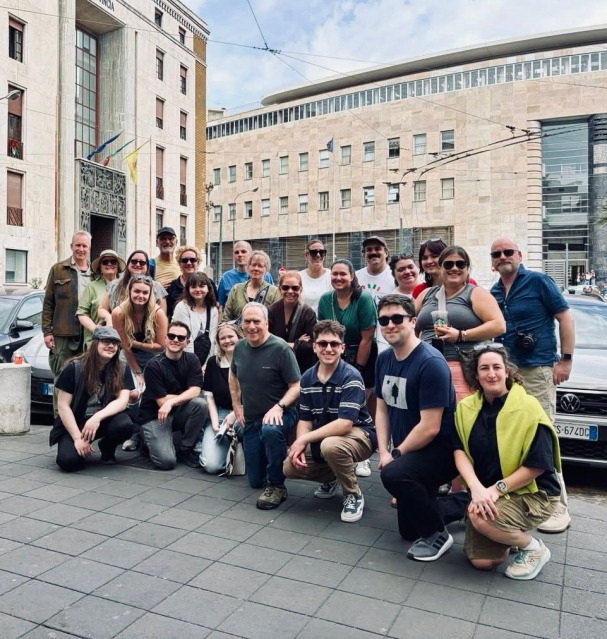
SALEM, MASS. – A graduate course led by Salem State University’s Center for Holocaust and Genocide Studies took 22 students, educators and community members to Italy in April, a week-long trip overseas to end a course exploring authoritarianism in Italian history and culture.
The course, “From Mussolini to the Mafia: Authoritarianism in Italian History and Culture,” was designed and taught by university faculty Stephenie Young and Christopher Mauriello. It explored themes of fascism and authoritarianism in Italian history and literature on campus during the spring semester, and it concluded with a one-week trip to sites in Naples, Palermo, Rome, and Sorrento. Travel took place during school vacation week, the second to last week in April.
“What we learned during the semester came alive in Italy from visiting sites ranging from Mussolini’s fascist state during World War II to the horrible mafia murders of judges and prosecutors in Sicily during the 1980s,” said Mauriello, who also leads the Center for Holocaust and Genocide Studies.
Added Young, “for me, it was striking to see our students move from the classroom into real-world experiences, learning not only the academic material but also about how to navigate a foreign environment, and how to work collaboratively as a group, while reflecting on their own roles as global citizens.”
It was a unique and powerful learning experience for the students involved.
“Combining the work from our seminar into this rich week of experiential learning was a powerful way to learn more about the mafia’s role in Italian society and culture during this period,” said Zachary LeColst, a graduate student in history who is completing his graduate certificate in Holocaust and Genocide Studies. “Beyond the impact of touring actual mafia sites and neighborhoods where this type of violence, corruption and extortion occurred, seeing these locations through the lens of our seminar’s literature made the experience uniquely profound as a historian.”
Each of the students in the international study and travel seminar were supported by CHGS scholarships made possible by donors to the Center for Holocaust and Genocide Studies.