
| Contact |
Dustin Luca
|
|---|
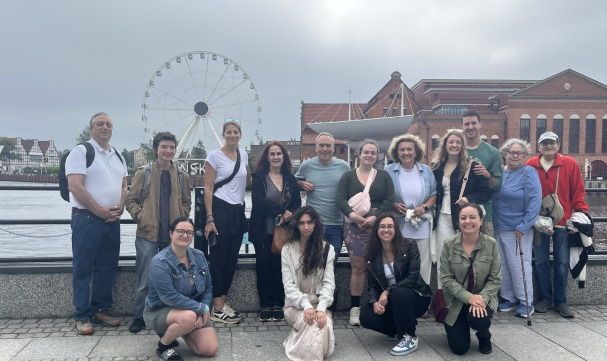
SALEM, MASS. – Fourteen Salem State University students, educators and community members spent nearly two weeks this summer traveling through Northern Poland, Lithuania, and Latvia, visiting the places where some of the darkest chapters of 20th century European history unfolded and examining how that history continues to be remembered today.
Titled The Holocaust and the Cold War in Northern Poland and the Baltics, the study and travel course brought participants to concentration camps, massacre sites, former ghettos, museums, memorials, and sites of Nazi and Soviet occupation. The program was offered through Salem State’s Center for Holocaust and Genocide Studies and its history department, and led by Visiting Associate Professor Regina Kazyulina and Professor Christopher Mauriello.
Before traveling, students participated in a three-day seminar at Salem State exploring the Holocaust, German occupation and the later Communist period. The course then moved into the places where that history occurred, allowing participants to consider not only what happened there, but how those events have been remembered and memorialized in the decades since.
The region has been described by historians as a “shatterzone of empires,” where larger geopolitical forces from the east and west profoundly affected the lives and relationships of the people living between them. Participants studied those forces and interethnic relations during the interwar period before examining the German occupation and the Holocaust.
Particular attention was given to the “Holocaust by Bullets,” in which most Jewish men, women and children in Latvia and Lithuania were murdered by Nazi Einsatzgruppen mobile killing units and their local collaborators beginning in the fall of 1941. The course also examined the ways this history has been remembered—and at times misremembered—during the Communist period and into the present day.
“How the traumatic history of the twentieth century is remembered, memorialized, and taught in parts of Eastern Europe remains a source of contestation in the region,” Kazyulina said. “It was particularly fascinating to be able to witness firsthand some of these memory wars and how public memory, particularly in Latvia and Lithuania, is being shaped by Russia’s war in Ukraine.”
The group began its travels on the Baltic Sea in Gdańsk, Poland, where participants visited the Museum of World War II and Stutthof Concentration Camp. From there, they traveled toward Lithuania, stopping at Hitler’s Wolf’s Lair in the forests of Northern Poland and the Ninth Fort in Kaunas, Lithuania.
In Vilnius, participants explored the history of Lithuanian Jews and the Vilna ghetto and visited the Paneriai Holocaust Memorial, where as many as 100,000 people, most of them Jewish, were murdered during the Holocaust. The group later traveled toward Riga, Latvia, stopping at the Salaspils Memorial Ensemble, a monumental Soviet-era memorial on the former grounds of the Salaspils Concentration Camp, and the Rumbula Forest Holocaust Memorial. In Riga, participants visited the Museum of the Riga Ghetto, the Museum of the Occupation of Lativia, and a former KGB prison.
For Mary Hawes Mahoney, a former Sudbury Public Schools teacher who participated in the trip, traveling to those locations offered an experience difficult to reproduce through classroom study alone.
“We visited memorials, museums, massacre sites, former KGB headquarters, a concentration camp, prisons, forts, and other pertinent and informative places that enhanced the trip,” Mahoney said. “Many of these sites were off the beaten path along gravel roads through forested lands. When time permitted in our well-curated trip, we were led to other locations that furthered our understanding of the culture and history of the locale.”
That transfer of knowledge is an important component of the CHGS program. The study and travel course was open for undergraduate and graduate credit, while educators could take the graduate course and convert the credits into professional development points. Students completing the course could choose to write an analytical essay focused on memory or develop a unit lesson plan based on what they learned.
Bringing educators into the program also creates opportunities for intergenerational learning among participants while extending the reach of the experience into their classrooms after they return.
Paul Chiano, a student in Salem State’s Holocaust and Genocide Studies certificate program and professor at Massasoit Community College, described the trip as an example of the potential of experiential education.
“THIS is what experiential learning should look like and be modeled after,” Chiano said. “The educational objectives of the program are applicable to teachers and students alike, and the learning that takes place will serve as the foundation of novel lesson plans and forward-thinking curricula.”
Students participating in the program were supported by CHGS scholarships made possible through Combined Jewish Philanthropies and donors to the Center for Holocaust and Genocide Studies.
Through that support, the lessons encountered across thousands of miles—from former ghettos and concentration camps to forests that became sites of mass murder and memorialization—can continue beyond the conclusion of the trip. For the educators who participated, what they encountered in Poland and the Baltics can now become part of how another generation learns and understands that history.
“The knowledge gained is something that is not necessarily attainable only in a classroom,” Mahoney added. “I know I will be sharing what I saw and learned with others.”