
| Contact |
Dustin Luca
|
|---|
SALEM, MASS. – Sixty years after a towering mural first chronicled Salem’s history inside Salem State University’s Meier Hall, a new work is reimagining that story through the people, communities and experiences that have shaped the city—and the students carrying that history forward today.
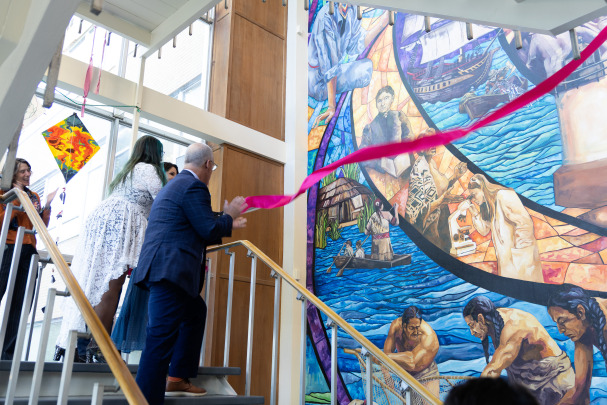
University leaders, artists, community members, and more unveiled “Chronicles of Salem Change Makers,” a four-story mural inside the Lafayette Street side entrance of Meier Hall, at a ribbon-cutting ceremony held Thursday night. The mural, now a part of both Salem State and the Punto Urban Art Museum, was completed by Hare & Howl, the collaborative muralism studio of artists Gabriela Sepúlveda Ortiz and Melissa Stratton Pandina, after a deliberative process that started from within a student movement a decade earlier.
The work replaces Robert E. Larter’s “A Chronicle of Salem,” a similarly sprawling mural that occupied the prominent Lafayette Street-facing Meier Hall stairwell from 1966 until its retirement earlier this year.
Rendered in the vibrant visual language of stained glass, the new mural uses a sweeping wave to carry viewers through centuries of Salem history. The story begins with the people of Naumkeag who lived along these shores long before European colonization. It moves through abolition, maritime and industrial Salem, generations of immigration, and the city’s changing communities before arriving at Salem State students today.
“For those who may not know, the previous mural, ‘Chronicle of Salem,’ was painted in 1966 by Robert E. Larter, then a member of the art department,” university President John Keenan told attendees of the ceremony Thursday night. “Over time, as the mural faded and our community evolved, many members of our campus began asking an important question: How can this space better reflect who we are today?”
A Decade in the Making
“A Chronicle of Salem” traced the city’s history from the colonial era through the 1960s, depicting Salem’s maritime, colonial, industrial, and educational history. Its subjects included John Endicott, the ship Arbella, the Salem Witch Trials, Nathaniel Bowditch, a scene connected to the Great Salem Fire of 1914, and Horace Mann.
Beginning in 2015 and 2016, however, Salem State students began raising concerns about what that telling of Salem’s history left out. Members of the Black Brown and Proud student movement questioned whether the mural’s focus on Puritan history reflected the university’s increasingly diverse student population or fostered a sense of belonging.
Years later, students working on Salem State’s land acknowledgment raised concerns that the mural’s depiction of Indigenous people reinforced a narrative in which Indigenous people disappeared from Salem’s history.
When Salem State formally adopted its land acknowledgement in 2023, one of its commitments called for university leaders and faculty, in consultation with the Massachusett Tribe, to consider changes to the Meier Hall mural. Salem State’s Roadmap to Servingness, also adopted in 2023, separately called for increasing murals, public art and displays that reflect the university community.
Those conversations ultimately developed into a collaborative process involving students, faculty, staff and community partners. Leaders within the university secured support for the project and worked with the Punto Urban Art Museum (PUAM), a program of the North Shore Community Development Coalition, to coordinate the effort. An advisory committee of students, faculty and staff helped guide the process, while students gathered additional feedback about what their peers wanted to see in the space.
In partnership with PUAM, Salem State then launched an international call for artists. Four finalists were invited to develop proposals, and members of the Salem State community and community partners were then invited to select the design. More than 300 people voted, ultimately choosing the proposal by Sepúlvida Ortiz and Stratton Pandina.
A Chronicle of Salem Changemakers
The resulting mural preserves familiar people and places from Salem history while considerably widening the lens.
At its base, people of Naumkeag gather shellfish, fish the shallows with nets and travel by canoe. Farther through the composition are Charlotte Forten, Salem State’s first African American graduate, as well as abolitionists Charles Lenox and Sarah Parker Remond, the city’s maritime and industrial history, and generations of immigrants who made Salem home.
The mural also depicts Operation Bootstrap and the migration that helped establish Salem’s Caribbean population, alongside hibiscus flowers and contemporary Salem State students. A Salem State art student appears wearing Native earrings, a deliberate representation of the continued presence of Indigenous people.
Historical figures including John Proctor, Roger Conant, Nathaniel Hawthorne and Nathaniel Bowditch who appear alongside the Witch House, Fort Pickering lighthouse, Naumkeag Steam Cotton Factory and other pieces of the city’s history. Contemporary students, including a graduate and baseball player, and university mascot Superfan carry the composition into the present.
The mural was executed by Hare & Howl, the collaborative studio of: Sepúlvida Ortiz, a Puerto Rican artist living in Western Massachusetts whose work explores history, labor and cultural resistance; and Stratton Pandina, a multidisciplinary Massachusetts artist and muralist whose work emphasizes portraiture and bringing peoples’ stories to life.
Their work on “Chronicles of Salem Change Makers” was further developed with campus and community input and in collaboration with the Punto Urban Art Museum. The project was led by Salem State’s Hispanic and Minority Serving Initiatives and supported by the Digital Ethnic Futures Consortium, with significant involvement from the community. Elisa Castillo, assistant vice president of HSI-MSI Initiatives, and Keja Valens, a professor of English, spearheaded the work.
Salem State marked the retirement of Larter’s mural in April with a lecture and tour exploring the work and its history. The university is also preserving the story of “A Chronicle of Salem” through a digital archival exhibit documenting Larter and the mural that occupied Meier Hall for six decades. That exhibit can be found here.
“Chronicles of Salem Change Makers” now carries that space’s tradition of storytelling forward. From the people of Naumkeag at its foundation to the students depicted at its height, the mural presents Salem’s history not as a story that has been completed, but one that continues to be written by the community living it today.
“Perhaps most importantly, this mural does not conclude the story. It opens it up,” Keenan said Thursday night. “Its arrival comes at a meaningful moment for Salem State, as we continue advancing student success, servingness and our mission as both an HSI-MSI and civic engagement university. It reflects not only how far we have come, but also the future we are building together.”
For more on the mural, please visit the Punto Urban Art Museum website here.